Hiring Benchmarks Report
The data behind the world’s highest-performing hiring teams.

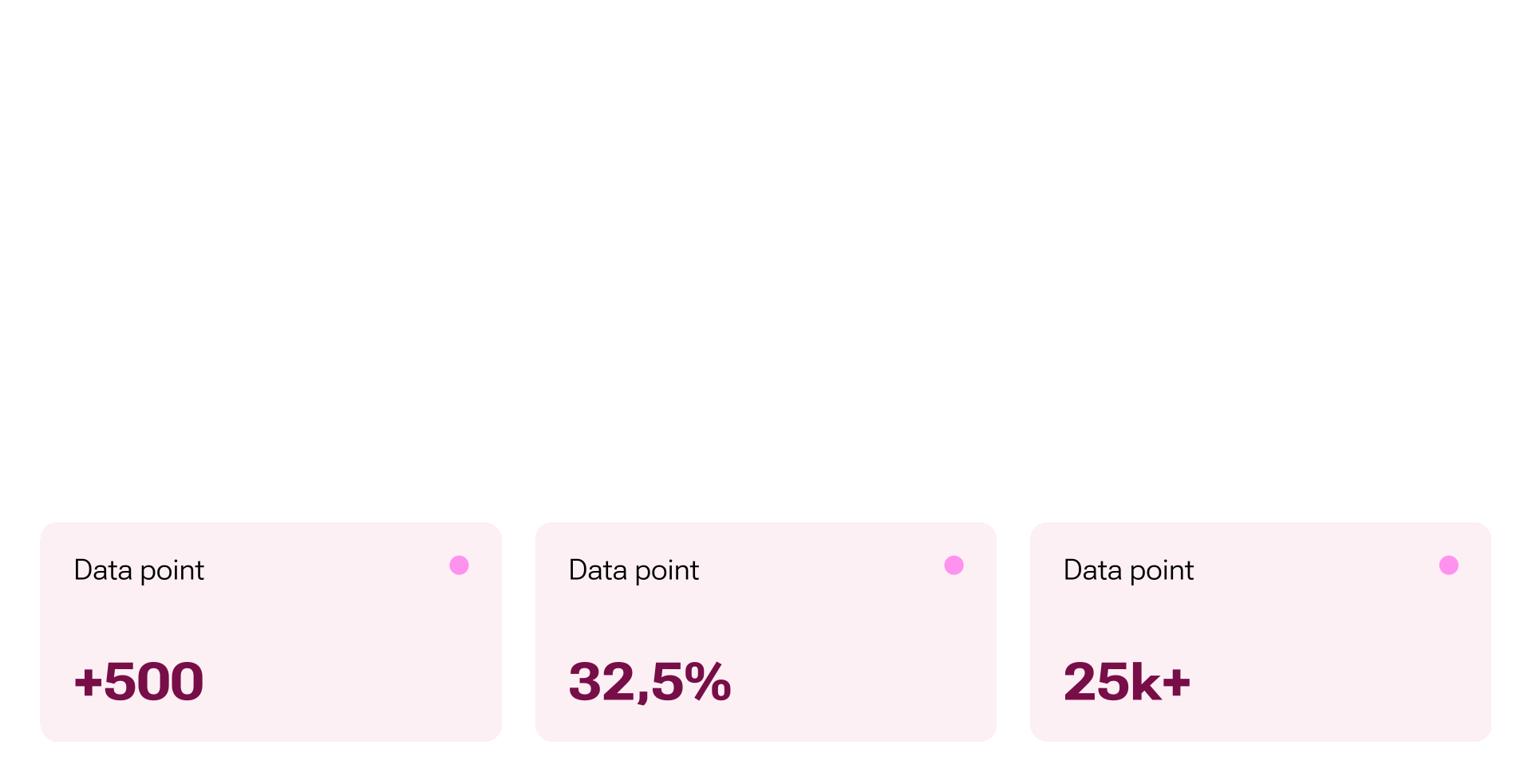
The year hiring scaled, but performance and experience didn’t follow.
If 2024 was the year of experimentation, 2025 was the year hiring changed completely.
Across industries, Talent Acquisition (TA) teams found themselves operating in a new reality. The use of Artificial Intelligence (AI) in hiring processes moved from pilot projects to daily workflows. Screening, scheduling, note-taking, drafting the job descriptions – tasks that once took hours became increasingly supported (and sometimes replaced) by technology. Driven by economic havoc and the rapid adoption of AI tools by candidates themselves, the volume of applications per job requisition continued to grow.
At the same time, TA teams (just like the rest of the world) were asked to deliver more – more efficiency, more quality and more strategic impact – often with leaner teams and rising business expectations.
For many, this shift brought real operational gains. Processes became more structured, decision-making felt more data-driven and Hiring Managers reported higher levels of satisfaction across our dataset. Internally, hiring began to look more mature.
This year’s Hiring Benchmarks Report is built on over 2.5M hiring experiences, making it our most comprehensive global dataset on hiring experience to date. When we examined the data across company size, department, source, journey stage and (for the first time ever!) industry, one thing became clear:
Hiring scaled, but performance and experience didn’t follow.


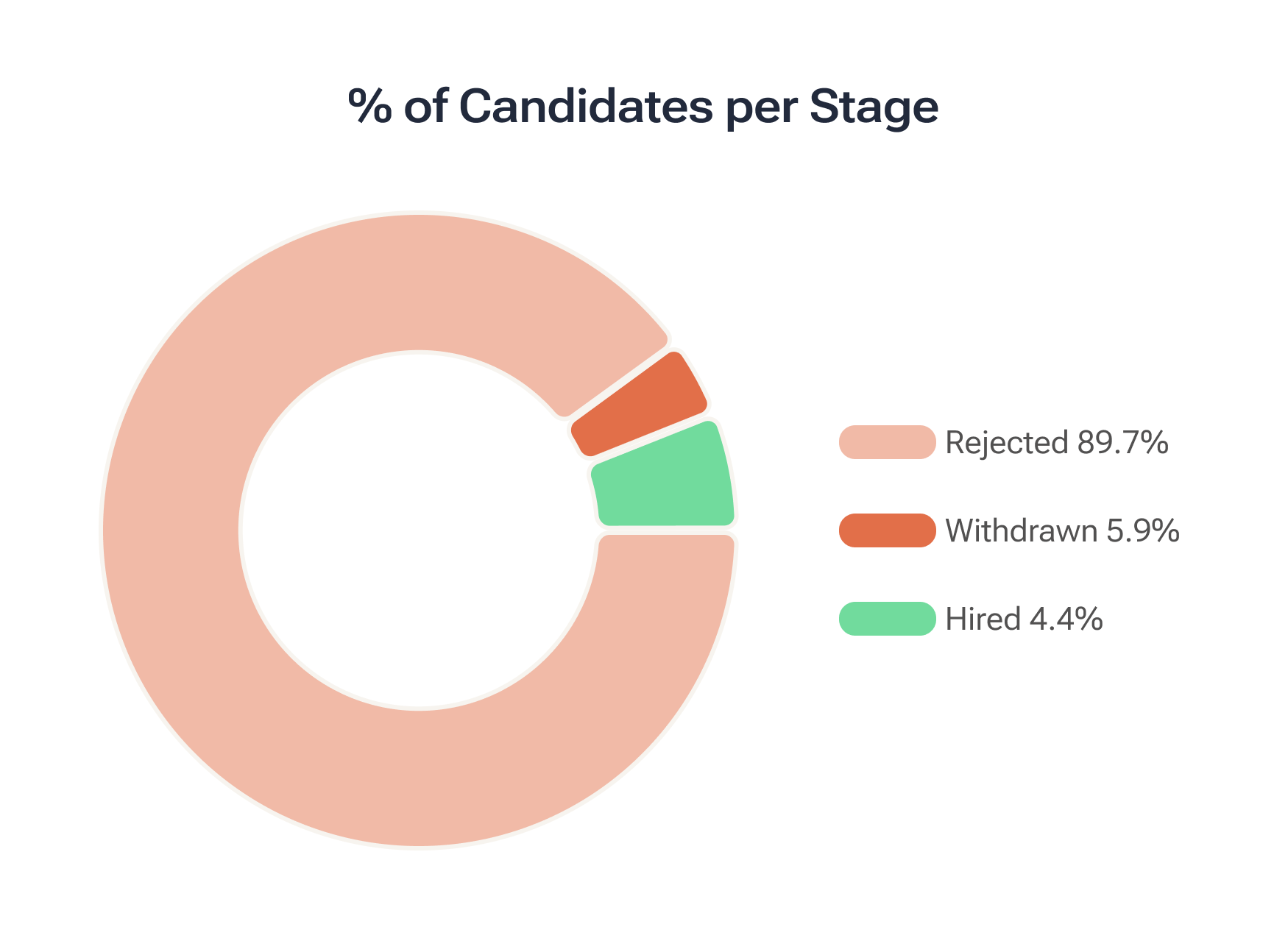
The global Candidate Experience Net Promoter Score (cNPS) sits at +17 – virtually unchanged from previous years. And compared to 82% in 2024, nearly 90% of survey invitations were sent to rejected candidates. Almost 70% of those rejections happened at the very first stage of the process, suggesting it’s more difficult for candidates to pass CV screening.
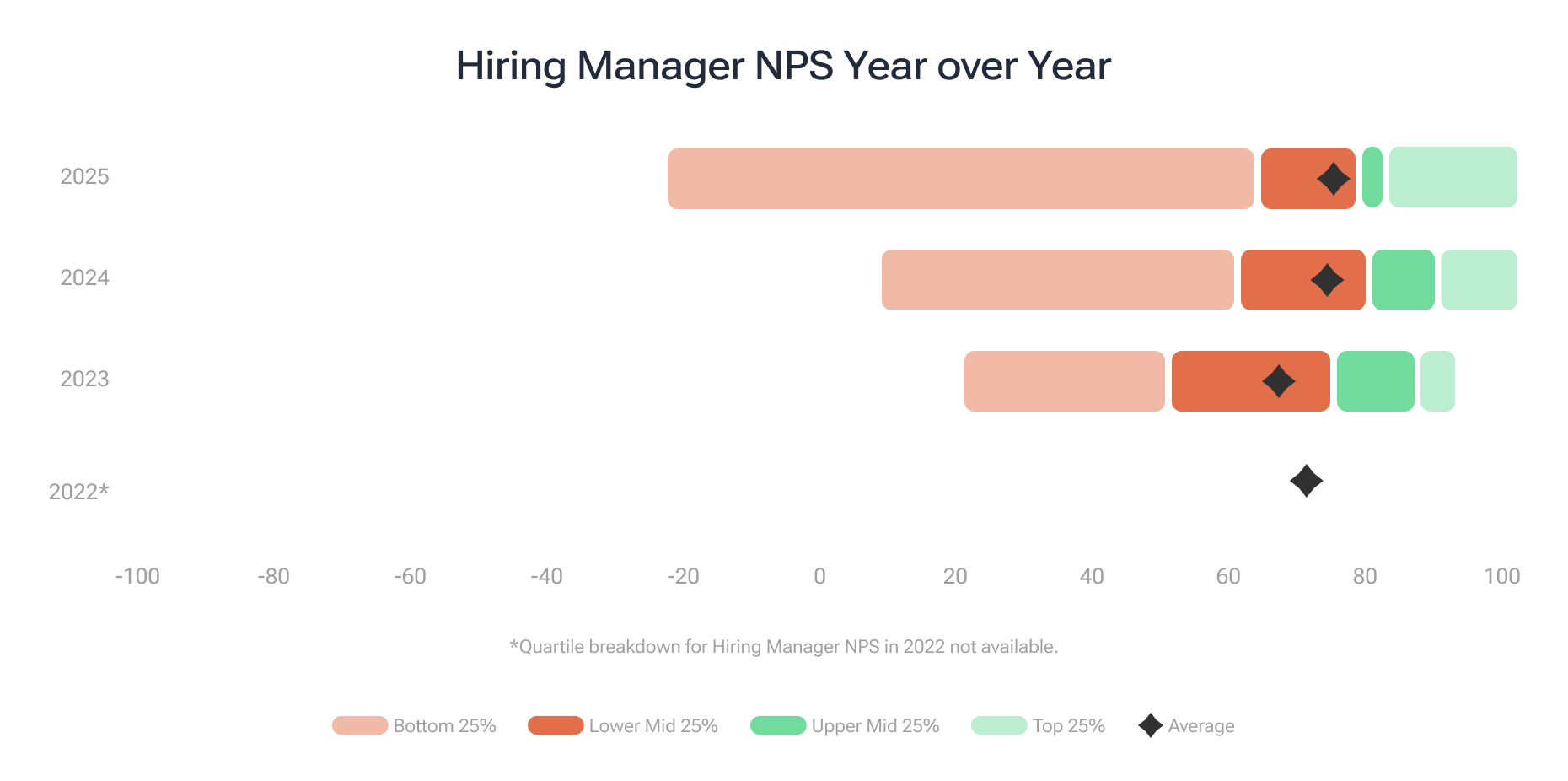
Meanwhile, Hiring Manager NPS has slightly risen to +73. Internally, hiring feels increasingly efficient and supported. Externally, candidates are confused, lack clarity and they are disappointed by the lack of human touch they experience.
So the stagnating Candidate Satisfaction Score doesn’t mean that hiring teams are underperforming. In fact, the opposite is often true. TA teams are working harder than ever, all the while investing in better tools and building stronger internal alignment. But the acceleration of automation and volume at the top of the hiring funnel has introduced new challenges, particularly around clarity, transparency and trust.
To understand where that friction originates, we analyzed candidate feedback using the Starred Candidate Experience Driver Framework. Across nearly 70,000 open-text comments, one driver consistently outweighed the other: Expectation Setting.
- How clearly is the role defined?
- How transparently is the process explained?
- How realistically are the timelines and compensation communicated?
- How are decisions justified?
When the recruitment process is governed by automation, expectation setting has become the defining performance lever.
Fortunately, while most teams operate around the baseline, some consistently outperform it.
For the second year in a row, we’ve awarded Starred’s Top Performing Hiring Teams – segmented by company size – who significantly outperformed their peers. What distinguishes them is not more technology nor complexity in the process, but discipline. They define what “great” looks like before opening a role, align deeply with Hiring Managers, they communicate candidly and they use AI deliberately, with clear boundaries and human ownership.

In the report that follows, we’re excited to explore the 5 defining trends that shaped hiring in 2025, before turning to what high-performing teams are doing differently as we move into 2026.
Download the raw benchmark data and compare your performance
If you already measure cNPS or Hiring Manager Satisfaction and would like to benchmark your performance against the world's best performing hiring teams, get a copy of our raw dataset.
The State of Hiring in 2026
If we look at this year’s data without interpretation, we get a clear picture:
Hiring became more selective at the very top of the funnel.
In 2025, 89.7% of all survey invitations were sent to rejected candidates and nearly 70% of them to candidates rejected at the application stage. This means that, compared to previous years, more candidates are being filtered out earlier, often before any meaningful human interaction occurs.

This shift reflects the surge in application volumes and the increased use of automation to manage that scale. But it also marks a structural change in how candidates are experiencing hiring today: the distance between them and the company they’re applying to is growing.
Unfortunately, the willingness from candidates to respond to surveys continued to decline across nearly every stage of the hiring process, suggesting a broader disengagement among candidates navigating increasingly automated recruitment experiences.

The overall experience remained stable, but stagnant. The global cNPS sits at +17, unchanged from last year. Rejected candidates remain in negative territory, while hired candidates are overwhelmingly positive. The gap between those two groups continues to define the state of Candidate Experience in 2026.


cNPS by Company Size
When we break the data down by company size, we get a consistent pattern. Smaller organizations (under 1000 FTEs) report significantly higher average cNPS scores than enterprises above 5000 FTEs. Larger companies, while operationally structured, experience more negative sentiment concentrated around automation, impersonal rejections and process delays.

cNPS by Industry
For the first time, we’ve also analyzed the dataset by Industry. Companies in the Technology & SaaS and Financial Services industries outperform most other sectors in overall experience, while Professional Services shows more friction, particularly at the rejection and hired stages. What’s interesting here is that Technology & SaaS, despite having the highest overall cNPS score, is the industry with most candidate withdrawals.
Skip to Trend 4: A “good enough” experience doesn’t guarantee a hire” to read more about this.


cNPS by Department
Roles in Operations & Logistics and Finance, Compliance & Legal tend to report better Candidate Experience than Marketing and Customer Service, Support & Success roles, where rejection rates are high and cNPS scores dip more sharply. Engineering, Product & Data teams show steady improvement year over year, though withdrawal rates remain elevated in competitive markets.


cNPS by Source
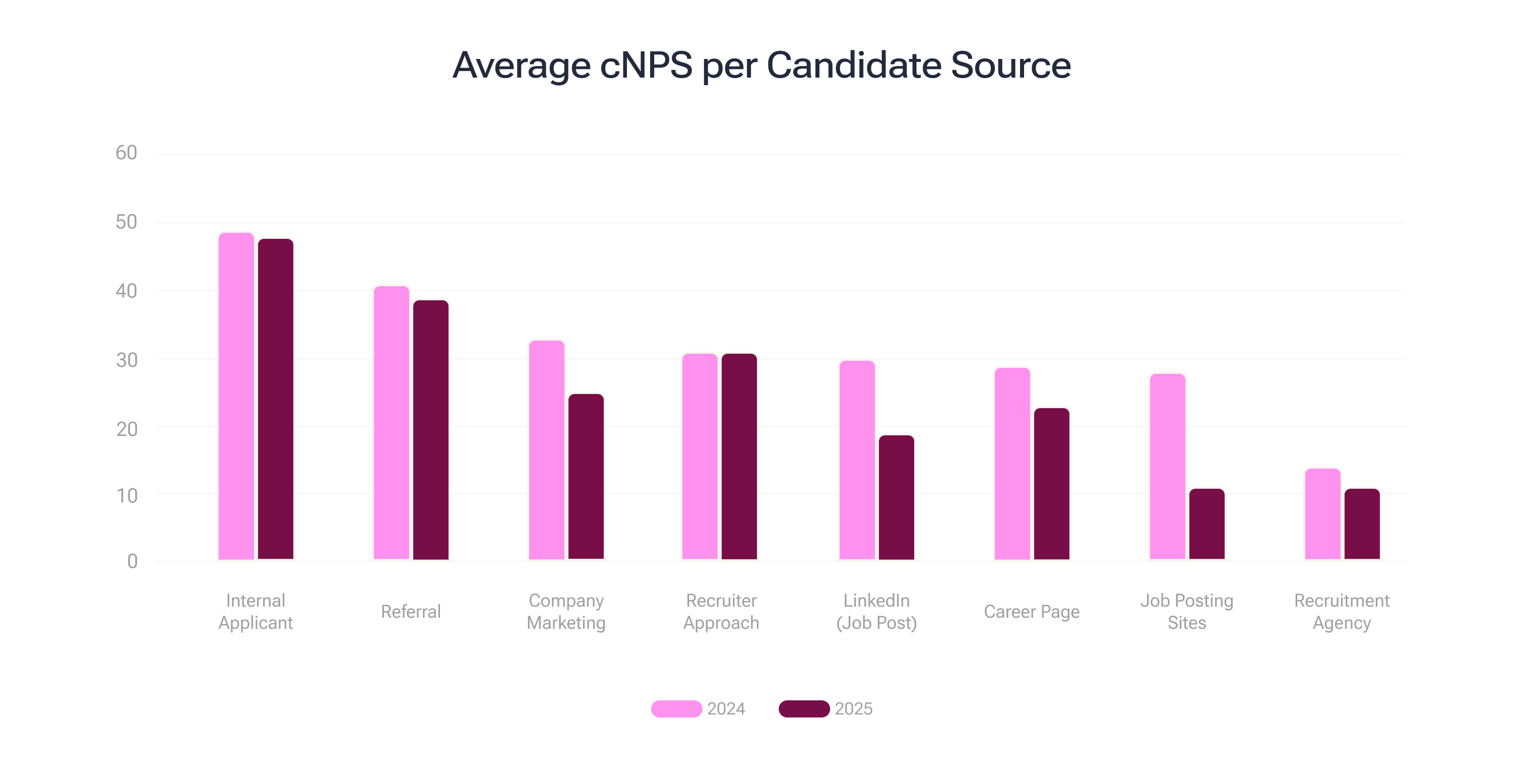
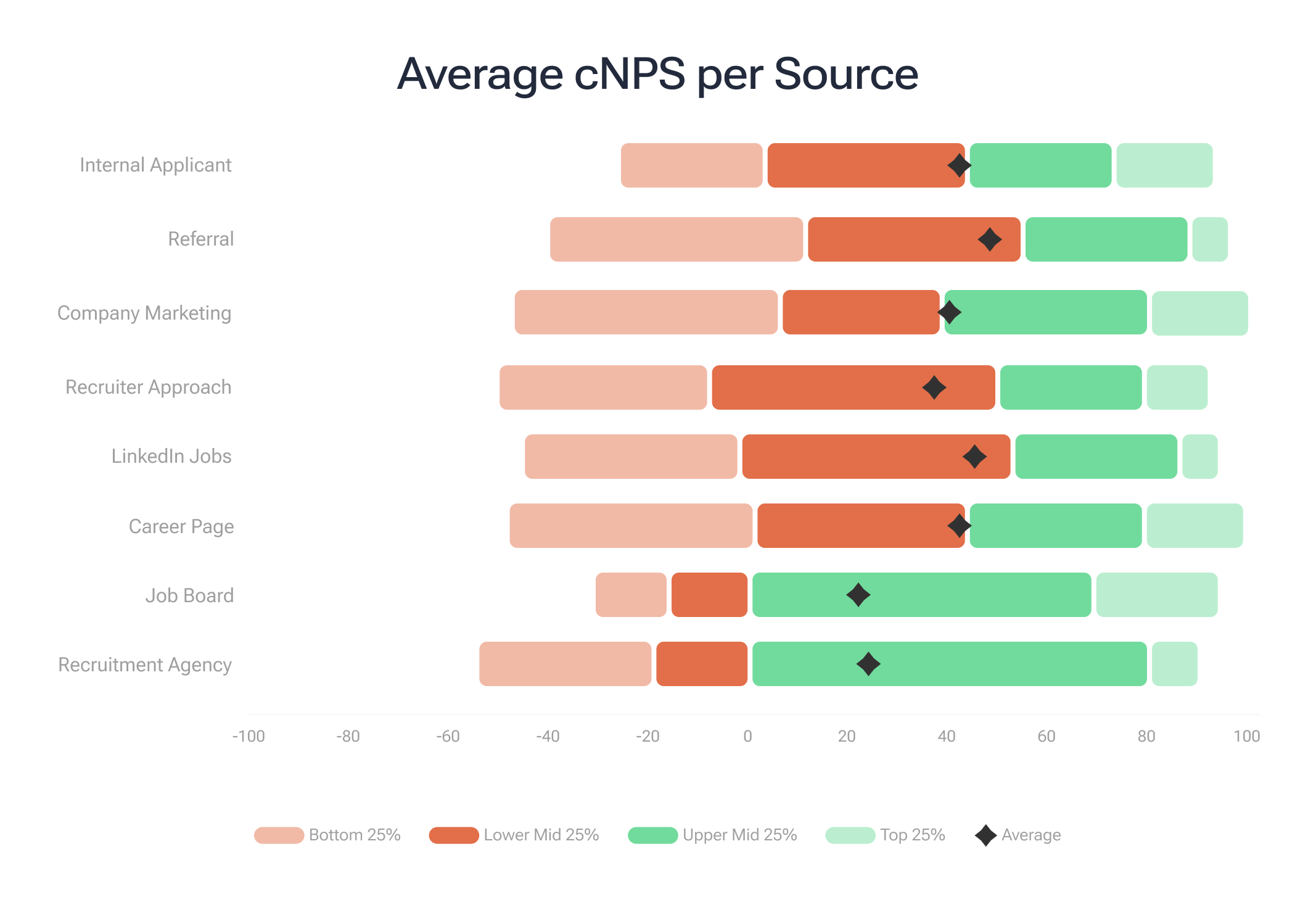
Looking at Candidate Source, Referrals and Recruiter Approach consistently outperform Job Posting Sites in both experience and sentiment. Candidates sourced through Job Posting Sites or Agencies report lower cNPS scores, particularly when rejected. Internal Applicants remain one of the most positively scoring groups overall, though even here, cNPS performance softened compared to last year.
Hiring Manager Satisfaction
Hiring Manager NPS rose again this year to +73 with smaller organizations reporting even higher satisfaction levels. Across industries, hiring managers cite improved structure, clearer alignment and better recruitment partnership.

So what are we working with in 2026?
When put together, the data suggests that the hiring environment in 2026 is quite different from just a few years ago.
Hiring in 2025 became more automated and more selective at the top of the funnel, processes became more structured and Hiring Manager Satisfaction strengthened. At the same time, Candidate Experience remained largely unchanged – and in some segments – increasingly fragile. Large organizations faced more friction around impersonality and delay. Certain industries and departments saw sharper drops in sentiment and across every breakdown, while Expectation Setting emerged as the most consistent source of dissatisfaction.
This is the context in which TA teams are now operating as we settle into 2026.
The next section explores the 5 major trends driving these outcomes. Evidently, hiring success in 2026 isn’t all about nuanced technology or additional tools. Instead, it’s increasingly defined by how processes are designed, communicated and experienced by all stakeholders involved.
It’s the Application Stage that defines your Candidate Experience
It’s no secret that many companies started hiring more efficiently in 2025. Or at least they tried to. But focusing on efficiency has made the entire process more top-funnel heavy: both in terms of application volume and the increased rejections at the first stage. With the help of automated screening tools, more filtering took place at the application stage, even before the candidate interacted with a recruiter or a hiring manager.
At first glance, this makes sense. When application volumes increased and AI-altered CVs became the norm, TA teams needed scalable ways to make the top of the hiring funnel manageable.
Automation became an operational necessity and this year’s data reflects this shift very clearly.
Nearly 90% of all survey invitations were sent to rejected candidates. Out of all the rejected candidates, 69.49% were rejected at the application stage, up from 62.4% in 2024. Fewer candidates progressed to phone screens, interviews or assessments, and overall withdrawal rates also declined.

Since many teams prioritized their hiring strategy for efficiency, this approach sounds rational. But from an experience perspective, candidates and TA teams were faced with a new dynamic.
When rejection happens before any meaningful (human) interaction, candidates do not have the necessary context to have a good experience unless you explicitly give it to them. They have no relationship with a recruiter, no explanation of how selection criteria were applied and no understanding of what would have differentiated them from others.
In the absence of a visible process and communication, candidates interpret what happened on their own, often ending up with a negative perception of the process, company or even the services they provide.
Automation with no context becomes emotionally charged
Across the dataset, more than half (56%) of all AI-related comments carry a negative sentiment. When zooming in on rejected candidates, almost a quarter (22%) of them reference AI or automated filtering in their comments.
This is not rocket science, but the pattern is consistent:
- Rejected and withdrawn candidates referencing AI are predominantly negative.
- Hired candidates referencing AI are overwhelmingly positive.

That is why using automation, but neglecting to inform the candidates on what it’s used for, can lead to such polarizing emotions. The same technology produces different perceptions depending on outcome. When candidates move forward, they comment on the company’s use of automation as efficient and organized. When they are rejected early without explanation, they perceive it impersonal, lazy or unfair.

The friction is not caused by the existence of automation itself. It is driven by the absence of transparency around how decisions are made.
The Strategic Shift: Don’t leave your Employer Brand up to interpretation
In previous years, dissatisfaction concentrated later in the journey: around assessments, interviews or feedback quality. In 2025, candidate frustration begins earlier. For most candidates, the rejection email now defines the experience.
This shift carries real implications for the Employer Brand. In a top-heavy hiring funnel, candidates form an opinion about the company before a recruiter ever enters the conversation. When the use of automation feels “sneaky” or communication lacks context, candidates fill in the gaps themselves. And those assumptions (whether accurate or not) shape how your company is remembered.
Looking ahead to 2026, early-stage filtering will only intensify. Application volumes remain high and AI-assisted applications are becoming standard. The strategic question is no longer whether to automate, but how to effectively pair automation with transparency.
In an era where the application process is the experience, only those teams that intentionally design this step will be able to maintain control over their Employer Brand.
Hiring Excellence starts with knowing where to focus.
Starred helps TA leaders improve quality, efficiency and experience.
Expectation Setting became the single biggest driver of candidate dissatisfaction
In 2025, the primary source of candidate frustration shifted away from traditional pain points like assessments, compensation and even rejection. Instead, the overwhelming dissatisfaction stemmed from unclear expectations.
Across the entire dataset, 37.8% of all comments from candidates mentioned the theme of Expectation Setting. Of those, 74.5% carried negative sentiment. This is significant because no other topic showed this level of concentrated dissatisfaction.

This pattern holds across all journey stages:
- 75.2% of all rejected candidates commenting on Expectation Setting were negative.
- 70.9% of withdrawn candidates were negative.
- Even among hired candidates, 39.1% expressed negative sentiment around Expectation Setting.
Rejection is an inevitable part of every hiring process, yet it’s not what damages experience most. Turns out, it's a lack of clarity.

What candidates mean by "poor expectation setting"
The negative sentiment clusters around 3 recurring themes:
| Theme | % of negative "Expectation Setting" comments |
|---|---|
| Lack of clarity or transparency | 24.9% |
| Timeline issues or delays | 9.2% |
| Misleading information compared to job description | 4.8% |
Candidates describe the hiring process as vague and lacking clarity on selection criteria. They also complain about unreliable timelines. Many explicitly mention missing information on:
- What was being assessed.
- What success looked like.
- When they would hear back.
- The reason for being rejected.
Expectation setting matters even more when automation is involved
In a hiring environment where rejections increasingly happen at the application level, Expectation Setting becomes even more important.

This is because when candidates reach the interview stage, or even go through a phone screening, they at least get some context. They meet the team, get an opportunity to ask questions and understand the assessment criteria or specific role requirements.
But when candidates are filtered out early (sometimes within a second of submitting their application, if the automation goes wrong), the right way to set expectations for candidates will do all the work.
This need is clearly highlighted by negative candidate sentiment in key areas across our dataset:
- Candidates rejected by companies in the Professional Services industry show 75% negative sentiment around Expectation Setting.
- Technology & SaaS, the industry with the highest withdrawal rates, sees candidates citing compensation misalignment that was not clarified early, meaning that the right expectations aren’t being set from the start.
- Large enterprises (5000+ FTEs) see that 71% of all negative comments concentrate around the company’s failure to set the expectations right.

The Strategic Shift: Clarity is no longer optional
Unclear expectations have always been a challenge, but in 2025 they started damaging company trust.
When nearly three quarters of all comments about Expectation Setting are negative, it represents a major problem in the recruitment sector. Looking ahead to the rest of 2026, hiring systems are unlikely to become simpler. Application volumes will remain high, AI-assisted submissions will increase and the need for early-stage filtering is now essential.
So don’t put the early stages of the recruitment process on the last place of your priority list.
To stand out in a hiring environment driven by automation and scale, clarity and effective Expectation Setting are crucial. This means:
- Role expectations must be specific and realistic.
- Salary positioning should be visible early to prevent late-stage misalignment.
- Process stages need to be explicitly defined, perhaps as early as the job description.
- Timelines must be clearly communicated and adhered to.
- Feedback, even when concise, will prevent candidates from filling in the gaps themselves.
- The use of AI must be communicated transparently.
The gap between Hiring Manager Satisfaction and Candidate Experience continues to widen
2025 showed us that TA teams strive towards Hiring Excellence; with more focus on quality, efficiency and experience across the hiring process. But this year’s Benchmark data proves that only one side of the coin is trending in the right direction.
Hiring Manager NPS reached +73 this year, up from +65 in 2023. Companies under 1000 FTEs reported Hiring Manager NPS as high as +85. Across themes such as recruiter collaboration, process clarity and role alignment, satisfaction ratings consistently exceeded 9 out of 10.
Internally, hiring feels stronger than ever. But while TA teams focused on internal alignment, Candidate Experience didn’t move at the same pace.
Overall, cNPS remains largely unchanged year over year. The average cNPS from rejected candidates sits at -7. Across industries and company sizes, the way candidates experience the process has not meaningfully improved despite more structure, more tooling and more internal discipline.

An internally-structured hiring process does not automatically feel fair to candidates
It seems obvious to assume that once the process is aligned internally, like magic, Candidate Experience should follow the upwards trend. Unfortunately, the further we break down this trend, the more we confirm it’s not that simple.
Across almost all breakdowns in this year’s dataset suggest that a more sophisticated or structured process doesn’t necessarily make the stakeholders involved happier – whether that’s candidates, recruiters or the hiring managers.
For example, the Company Size lens suggests that smaller organizations (below 1000 FTEs) report higher Hiring Manager satisfaction and stronger candidate cNPS than their larger counterparts. You would think that the larger the company, the more sophisticated the recruitment process. In reality, enterprises with over 5000 FTEs, while operationally mature, show both lower candidate cNPS and Hiring Manager Satisfaction scores.

Looking at the data by Candidate Source, we see that sources involving direct recruiter interaction (e.g. Recruiter Approach with a cNPS of +43) outperform more transactional channels, such as Job Posting Sites (+20 cNPS). When candidates experience visible human ownership, overall sentiment improves. When the process feels too automated or distant, their experience drops even if the internal process is well-managed.
Industry comparisons reinforce the same dynamic. Technology & SaaS companies, where hiring processes are often well-structured and data-driven, show relatively strong overall cNPS (+24), but also the highest withdrawal rate at 13.5% (8.5% above this year’s average). But more on this in the next chapter.
The Strategic Shift: Give the candidates a proper seat at the table
This widening gap tells us that internal optimization alone is not enough. Hiring managers may feel clearer, more aligned and better supported, but unless that same clarity is deliberately extended to candidates, the system remains strong on the inside, yet disappointing from the outside.
Designing a candidate process that gives applicants a genuine voice requires clarity and structure so candidates can fully grasp what's expected, regardless of making the selection criteria easier.
High-performing TA teams treat good communication as a performance lever. They define what success looks like before the search begins and ensure it’s reflected consistently throughout the process. They align on compensation and scope early enough to avoid preventable withdrawals. They structure assessments so that evaluation criteria are visible, rather than implied. And when they make decisions, they communicate them in a way that doesn’t come as a surprise.
When candidates understand how they are being assessed, what trade-offs are being made, and what timelines to expect, even rejection can feel fair. Without that visibility, the same decision feels arbitrary – regardless of how disciplined the internal process may be.
Today, hiring excellence depends less on how sophisticated your internal system is and more on whether your candidates are in the loop enough to understand it. What will differentiate your team in 2026 is flipping the narrative: instead of prioritizing efficiency for efficiency’s sake, prioritize the candidates and the rest will follow.
Get the raw performance benchmarks behind the world's highest-performing hiring teams.
A “good enough” experience doesn’t guarantee a hire
If there is one area that reflects the tension of 2025 most clearly, it is breaking down our dataset by industry and zooming in on Technology & SaaS.
On the surface, this industry appears relatively healthy from a Candidate Experience perspective. The overall cNPS sits at +24, placing it above most other industries in the dataset. Even more striking, candidates who voluntarily withdrew from processes in this sector report a cNPS of +42 – a score that, in isolation, would suggest a strong and well-managed experience.
And yet Technology & SaaS also records the highest withdrawal rate at 13.5%, significantly above the cross-industry average.

This combination – a relatively positive sentiment paired with increased withdrawal – forces a more nuanced interpretation. When examining the comments left by withdrawn candidates, the issue isn’t dissatisfaction in the traditional sense. It's a lack of momentum.
The dominant themes we found in comments from withdrawn candidates in the Technology & SaaS industry were not the usual culprits like hostility or frustration. Instead, they pointed to process misalignment that became visible only over time.
Almost 1/5 of comments in this industry segment referenced communication gaps, unclear next steps or insufficient feedback. Close to 9% mentioned slow timelines or extended decision cycles. A similar proportion highlighted compensation misalignment that surfaced too late in the process and a few candidates even explicitly stated that they left purely because of a competing offer.

Taken together, this suggests that candidates are not leaving because they dislike the organization or the people they meet. They are leaving because the process creates space for alternatives to become more attractive.
In competitive markets, speed and clarity function differently than in more stable segments. Candidates often engage in multiple processes simultaneously. So when salary positioning is clarified only at the offer stage or when internal alignment delays a decision, even a respectful and well-structured experience can lose its edge.
The +42 cNPS among withdrawn candidates is a signal that goodwill alone is no longer sufficient to secure the dream candidate.

This is particularly relevant in a year where hiring scaled and operational maturity improved. Many Technology & SaaS teams report stronger internal alignment, clearer frameworks and better tooling than in previous years. But – as we established already – improving the internal structure does not automatically translate into faster decisions or better transparency. And in competitive environments, like Technology & SaaS, that gap becomes costly.
The Strategic Shift: Optimize for conversions, not just sentiment
In high-demand markets, a “good” process is not enough. What matters is whether the process is optimized for the right outcome.
Technology & SaaS teams have shown us that even when your process looks good on paper, you might still not be able to fill the role. In many cases, these TA teams are among the most operationally mature in the dataset. They measure experience, standardize interviews and invest in tooling, but withdrawals still remain high.
The nuance in the feedback points to something more specific: the friction that drives withdrawal is rarely dramatic. It sits in the details and that’s why optimization needs to become more precise.
The objective shouldn’t be increasing cNPS in isolation. So rather than broadly improving “the experience,” high-performing teams analyze feedback in combination with other signals: stage-level drop-offs, time-in-stage, offer acceptance rates and compensation competitiveness. They identify where uncertainty accumulates and where momentum weakens to tweak those exact moments in the process with the aim of improving conversion.
In competitive segments, hiring performance is decided less by whether candidates feel generally positive and more by whether friction is removed at the exact points that influence commitment. The teams that win in 2026 will be those that stop optimizing for surface-level improvements and instead focus on the moments that get the perfect candidate to sign their contract.
Hiring Excellence starts with knowing where to focus.
Starred helps TA leaders improve quality, efficiency and experience.
As organizations scale, hiring performance becomes harder to sustain
When we look at the data by Company Size, we get an interesting paradox. On the one hand, smaller organizations are praised for the human touch in their process, but candidates criticize the lack of proper structure. On the other hand, candidates applying for enterprise jobs appreciate the systems put in place, but complain about the lack of personalization and excessive bureaucracy.

In smaller organizations (1-500 FTEs), the experience is primarily shaped by people. Positive comments emphasize recruiter partnership, speed and direct communication. Even when processes are imperfect, the experience is described as human and responsive. Negative feedback in this segment tends to focus on limited structure, shifting requirements or resource constraints.
As organizations grow into the mid-market (501-5000 FTEs), sentiment becomes more dependent on process consistency. Candidates appreciate structured interviews and clearer role alignment, but frustration increasingly centers on internal delays or late-stage changes.
In enterprises above 5000 FTEs, the dynamic shifts again. Positive comments emphasize brand strength, career opportunity and scale of impact. Negative sentiment, however, concentrates on bureaucracy, slowness and impersonality. More than 1/3 of negative comments in this segment explicitly reference impersonal or automated rejection, with internal alignment delays and multi-layered decision-making close behind.
| Theme | % of negative comments in the >5000 FTEs category |
|---|---|
| Impersonal or automated rejection | 33.4% |
| Failure to set the right expectations | 13.7% |
| Significant process delays | 12.9% |
Our data suggests that the larger the company becomes, the more the risk shifts from inconsistency to impersonality. And unless the hiring process scales with intention, efficiency gains can slowly overshadow the very interactions that make hiring effective.

The Strategic Shift: Remove friction as soon as you spot it
Impersonality and delays in larger organizations are not inherent consequences of scale. Rather, they signal that certain process steps are no longer effective in achieving their original goals.
At scale, the hiring architecture cannot be static. It needs continuous recalibration based on what the process itself is telling you. Where are candidates withdrawing? At which stage does sentiment drop? Where do time-in-stage metrics stretch without improving decision quality? When does compensation misalignment surface and how late in the funnel does it appear?
High-performing teams do not treat feedback as a retrospective report. They use it as operational input and connect candidate sentiment to stage-level performance, withdrawal rates and offer acceptance. When a pattern appears (like repeated comments about vague next steps, delayed decisions or unclear expectation setting) they adjust the system in response.
This is where scale becomes an advantage rather than a liability. With enough data, friction moves from being anecdotal to measurable.
In 2026, scaling successfully will depend on how quickly organizations translate those signals into structural changes. The teams that remove obstacles in real time – rather than defending legacy processes – will be the ones that secure the talent their organization needs.
What the Top 10 do differently
For the second year in a row, we identified Starred’s Top 10 Hiring Teams across two segments.
Following the massive success of last year’s Report, we're excited to announce the highly anticipated second annual ranking of Starred's Top 10 Hiring Teams.
This year, we're doubling down on our commitment to celebrating excellence and high performance in the TA sector to honor the organizations that have truly mastered the art of creating exceptional candidate and hiring manager experiences.
Recognizing that one size doesn't fit all in TA, the Top 10 Hiring Teams will again be structured into two critical and distinct categories:
- Top 10 Enterprise Hiring Teams (1000+ FTEs): Highlighting the achievements of large organizations navigating high-volume recruitment, complex global operations and highly specialized talent pools.
- Top 10 Emerging Hiring Teams (>1000 FTEs): Celebrating the agility, rapid growth and impactful strategies of smaller, fast-scaling companies building their world-class workforce quickly and efficiently.
These teams significantly outperformed their peers on candidate experience, consistency and hiring performance. So join us in celebrating their successes!
Companies under 1000 FTEs:
- Zip Co
- Chaos
- SMG Swiss Marketplace Group
- Prosper
- Preply
- Bitpanda
- GoCardless
- Spire Global
- Neo4j
- Moloco
Companies over 1000 FTEs:
- Wargaming
- Royal BAM Group
- Figma
- Elastic
- Coca-Cola
- Entain
- One Acre Fund
- Wolt
- GoDaddy
- IQ-EQ
What makes this particularly interesting is the context in which they operated. They faced the same pressures as everyone else: mass applications, AI-assisted CVs, internal resource constraints, rising expectations from the business. Yet their results continuously showed up higher than the benchmark.
So we took the opportunity to ask them a few questions to understand what they did differently and here are the 5 trends that emerged:
1. Quality of Hire becomes the North Star metric
In 82% of our interviews, Quality of Hire or decision quality was explicitly described as the most important outcome. Speed, satisfaction and retention were framed as the downstream effects of getting hiring decisions right.

These teams define quality beyond short-term fill rates. Several of them reference structured hiring manager feedback, 6-12 month performance checkpoints and retention milestones as part of their feedback loop. In other words, hiring is evaluated not just at offer acceptance, but also once the new hire’s impact becomes visible inside the business.
This focus reshapes their approach to trade-offs in the recruitment process. When quality is the North Star, interview design becomes more disciplined, role definitions become sharper and hiring managers become more accountable. Speed is still valuable (around 73% referenced efficiency as important), but it is rarely optimized in isolation.
2. Speed and trust are a byproduct of good clarity and structure
91% of the companies interviewed emphasized structured interviews, standardized frameworks or clear role definitions as performance levers. More than half explicitly described defining “what good looks like” even before opening a role.
The key takeaway from this year’s report is clear: Since poor expectation setting is the leading cause of dissatisfaction globally, the most successful teams preempt this risk by embedding clarity into their hiring process.
Interview questions are standardized, evaluation criteria are explicit and interviewers are trained or certified. In some cases, formal hiring frameworks were rolled out across regions to ensure consistency. Candidates understand what is being assessed and hiring managers understand what strong performance looks like, so success is inevitable.
The result is a process that moves with fewer recalibrations mid-funnel, which in turn reduces withdrawal and misalignment.
They achieve this by standardizing interview questions, using explicit evaluation criteria, and ensuring interviewers are trained or certified. Some organizations even introduced formal, region-wide hiring frameworks to guarantee consistency. This systematic approach ensures candidates know exactly what they are being assessed on, and hiring managers have a precise definition of strong performance, making successful outcomes highly predictable.
Ultimately, this structure minimizes the need for mid-funnel adjustments, which significantly reduces candidate withdrawal and misalignment down the line.

3. Talent Acquisition operates as a strategic partner, not a delivery function
Across the Top 10, the TA function does not wait for a list of requests to begin working. These teams have earned their seat at the table by consistently improving hiring outcomes and by grounding their recommendations in data, not opinion.
They bring market intelligence, historical performance data and feedback insights into workforce planning conversations. When a brief is unrealistic or compensation is misaligned with market conditions, they challenge it early. When trade-offs between speed, scope and quality need to be made, they make those trade-offs explicit with the business. Hiring managers are not simply supported through the process; they are coached, enabled and held accountable for decision quality.
One organization described how formalizing feedback loops and modernizing its hiring infrastructure increased Hiring Manager NPS from +10 to +60. This sharp increase was a direct result of TA clarifying expectations, aligning stakeholders earlier, and making performance measurable, rather than just becoming more service-oriented.
This directly addresses one of the structural tensions we identified in the benchmark data above: internal satisfaction can improve while external perception remains flat. But high-performing teams reduce that disconnect by ensuring that the discipline and clarity achieved internally are reflected consistently in how candidates experience the process.
In these organizations, hiring is treated as a shared business responsibility. TA shapes the conditions that determine hiring success rather than simply managing the workflow.

4. AI is widely adopted, but bounded by human ownership
91% of the Top 10 actively use AI in their hiring workflows. However, 64% explicitly state that AI is not used to make final hiring decisions. The pattern is clear: automation handles administrative load, while any decisions regarding candidates remain human.
AI is used for scheduling, note-taking, job description drafting and consistency in communication. At the same time, several companies reported new friction points introduced by AI, including application volume spikes, authenticity concerns and weaker resume screening quality. 3 companies explicitly reduced or avoided AI screening tools after observing a drop in quality.
In a year where nearly 70% of rejections happen at application stage and AI-related comments skew negative among rejected candidates, this distinction is key. High performers do not remove humans from the process; they remove administrative burden so humans can focus on evaluation, communication and trust.

5. The hiring process evolves according to feedback
High-performing companies, as reported by 82% of those surveyed, utilize systematic, feedback-driven iteration. What sets these teams apart is their proactive approach to acting on the feedback they receive.
They achieve this by cross-functionally reviewing data points such as candidate comments, hiring manager feedback, and performance signals. Upon identifying a pattern, they immediately implement structural adjustments.
For example, one organization executed 224 system or process upgrades after reviewing over 300 change requests from candidate and stakeholder feedback in a single year. Similarly, another team cut a two-week test assignment down to one week following persistent complaints.
This behavior underscores a key finding from this year’s Benchmark Report: significant operational friction seldom results from one major breakdown but instead accumulates from minor, repeated signals. Top performers recognize these signals as valuable operational data to improve on, not just an isolated opinion.

Our advice for other high-performing hiring teams
The most significant takeaway to bring with us into 2026 is that AI's role in hiring has evolved beyond experimentation into something integral, whether we like it or not.
Automation now supports key functions across the majority of teams analyzed in this report – including a notable 91% of our Top 10 – with tasks such as screening candidates, scheduling interviews, taking notes and drafting communications already being routinely assisted by or outsourced to Artificial Intelligence.
The question now is whether these hiring systems are designed to convert our new-found efficiency into hiring performance.
This year's data reveals three key findings: automation without transparency erodes trust; initial candidate filtering impacts Employer Brand perception more than later interviews; and internal team alignment doesn't guarantee candidate satisfaction.
We also found that high-performing teams manage technology effectively instead of rejecting it. They safeguard human judgment in critical areas, maintain open communication about decision-making processes and constantly watch for and address areas of friction.
Looking further into 2026, three dynamics are likely to intensify:
- AI-assisted applications will drive up application volumes, requiring better screening tools and strategies.
- Attracting top talent in competitive segments demands data-driven process optimization, not just a positive Candidate Experience.
- As organizations grow, maintaining clear role definitions and ownership in hiring will be critical to counter the increasing process complexity.
We also expect Quality of Hire to become more formalized as a metric. Many of this year’s top performers already evaluate performance at 6–12 months, set retention milestones and measure hiring manager confidence as part of their evaluation loop. As hiring becomes more data-rich, the ability to connect Candidate Experience, decision quality and downstream performance will become a strategic advantage.
The benchmark sets the baseline. What you choose to measure (and how quickly you act on it) will determine whether your hiring performance improves from here.
Afterword
At Starred, we believe hiring performance is measurable, improvable and deeply connected to business outcomes.
This report is built on more than 2.5 million hiring experiences and nearly 70,000 open-text comments. Behind every data point is a candidate who chose to share how the process fellt and a team willing to listen. We are grateful to the organizations that continue to measure consistently, question their assumptions and adjust their systems based on evidence rather than intuition.
If 2025 was the year hiring scaled, 2026 will be the year hiring systems are tested. Efficiency alone will not differentiate teams. Clarity, accountability and the ability to remove friction in real time will.
We hope this year’s insights help you look at your own process with sharper questions:
- Where does sentiment drop?
- Where does momentum slow?
- Where does structure help and where does it accumulate without adding value?
If you would like to explore how Starred can help you connect candidate feedback, hiring performance and Quality of Hire into one measurable system, we would be happy to continue the conversation.
Thank you for taking the time to read this year’s Hiring Benchmarks Report. We look forward to seeing how the data evolves in 2026.
Ready to compare your performance against benchmark?
Download a copy of our raw dataset to compare your hiring performance against the world's best performing TA teams.